Industrial Process Measurement and Control: Key Standards for Smarter Manufacturing

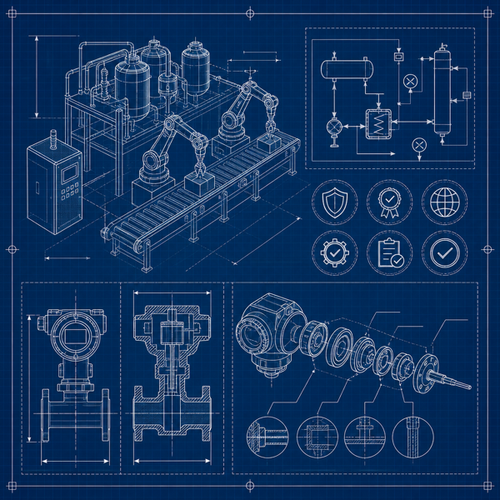
Industrial process measurement and control form the core of modern manufacturing, ensuring operations run efficiently, securely, and at scale. As digital transformation accelerates, businesses now more than ever rely on robust international standards for integrating new technologies, eliminating silos, and supporting both legacy and cutting-edge equipment. In this guide, we’ll explore four essential standards that define the framework for seamless data exchange, secure architectures, and reliable automation—from the shop floor to enterprise management.
Implementing these standards isn’t just about ticking compliance boxes; it’s vital for growing productivity, enhancing plant security, and scaling up to meet evolving industry requirements. Whether you’re deploying interconnected sensors, optimizing business operations with IT/OT integration, or building real-time alarm systems, understanding and applying the right standards sets the groundwork for smart, future-ready factories.
Overview / Introduction
Manufacturing industries face mounting challenges—rapid technological change, the rise of the Industrial Internet of Things (IIoT), cybersecurity threats, and the continual need to improve productivity. International standards for industrial process measurement and control serve as a universal language for devices, systems, and organizations, harmonizing how information flows and processes are managed.
With digital transformation at the forefront, standards such as EN IEC 62264-2:2026(Enterprise-Control System Integration), and OPC Unified Architecture (as detailed in EN IEC 62541-3:2026, EN IEC 62541-14:2026, and EN IEC 62541-9:2026) establish the rules and models that keep information secure, interoperable, and actionable.
In this article, you’ll learn:
The scope and significance of four key standards
Practical requirements for each standard
How adopting these frameworks boosts integration, productivity, and resilience
Implementation strategies and compliance insights for manufacturers
Let’s dive into each standard for a closer look.
Detailed Standards Coverage
EN IEC 62264-2:2026 – Object Models for Enterprise-Control Integration
Enterprise-Control System Integration – Part 2: Object models and relationships for interfaces between manufacturing operations and business functions
What it covers and its scope: EN IEC 62264-2:2026 specifies the object models and relationships necessary for integrating manufacturing control functions (such as shop floor automation) with higher-level business operations (like ERP, supply chain, and MES). By translating industrial process data into harmonized information structures, it enables seamless, error-free data exchange between disparate systems. This is especially critical at the Level 3 (manufacturing operations) and Level 4 (business systems) boundary, as defined by the hierarchical model in the first part of IEC 62264.
Key requirements and specifications:
Defines a robust set of conceptual object models (personnel, equipment, material, operations, etc.), encapsulating manufacturing and business data
Outlines attributes and object relationships, including operational events, records, schedules, test models, and capability information
Provides guidance for mapping domain-specific standards to a generalized interface, ensuring future flexibility and interoperability
Incorporates mechanisms for extending the base interface with custom attributes or models, accommodating unique business needs
Introduces support for uncertainty in measurement data, critical in modern data-driven manufacturing
Who needs to comply: Ideal for manufacturing organizations integrating MES, ERP solutions, IT/OT architectures, or seeking to implement “smart manufacturing” and Industry 4.0 strategies. System integrators, automation engineers, and IT professionals involved in plant-to-business integration benefit most.
Practical implications:
Lowers the risk and cost of connecting disparate manufacturing and enterprise applications
Standardizes the data vocabulary, dramatically reducing misunderstanding and integration errors
Enhances agility in adapting to new technologies or changing market requirements
Notable features:
New object models for interactive communications and event notifications
Enhanced models for operation locations and spatial attributes
Refined models for test specifications linked to operational data
Changes for improved inheritance, resource relationships, and data persistence
Backward compatibility not guaranteed due to extensive technical updates
Key highlights:
Unified data model for enterprise and shop-floor integration
Support for complex, scalable, real-time architectures
Mechanisms for extending and customizing interface content
Access the full standard: View EN IEC 62264-2:2026 on iTeh Standards
EN IEC 62541-14:2026 – OPC UA PubSub for Flexible, Real-Time Communication
OPC unified architecture – Part 14: PubSub
What it covers and its scope: EN IEC 62541-14:2026 describes the Publisher-Subscriber (PubSub) communication model as part of the OPC Unified Architecture (OPC UA). This model complements the traditional client/server approach, enabling high-performance, scalable, and real-time data distribution to multiple subscribers across device networks, IT systems, and cloud environments.
Key requirements and specifications:
Defines PubSub concepts, configuration parameters, configuration models, and mappings to popular protocols (e.g., MQTT, AMQP, UDP, JSON)
Introduces messaging layers, security key management, and support for both periodic and event-driven data
Details on the “Quantity Model,” allowing engineering units, quantity conversion, and value precision rules
Security provisions for encrypting and authenticating communication over public and private networks
Who needs to comply: Essential for automation engineers, industrial IT architects, device manufacturers, and software vendors aiming to build or deploy secure, scalable OPC UA-based architectures. Especially relevant for IIoT, predictive maintenance, and cloud analytics applications.
Practical implications:
Enables near real-time, deterministic messaging for mission-critical control loops
Facilitates automation architectures where topics and observers (subscribers) change dynamically at runtime
Supports secure information flow across operational and business technology domains
Notable features:
Addition of a comprehensive “Quantity Model” with engineering unit references and unit conversion
Refined rules for precision and value representation, essential for accurate industrial analytics
Expanded mapping to broker-based publish/subscribe patterns (MQTT, AMQP)
Key highlights:
Flexible, scalable, and secure data exchange for IIoT
PubSub fit for large, distributed, and dynamic manufacturing ecosystems
Enhanced support for unit management and precise measurement
Access the full standard: View EN IEC 62541-14:2026 on iTeh Standards
EN IEC 62541-3:2026 – OPC UA Address Space Model
OPC unified architecture – Part 3: Address Space Model
What it covers and its scope: EN IEC 62541-3:2026 standardizes the meta model for the Opc Unified Architecture (OPC UA) Address Space— the backbone for information models used in industrial automation systems. The Address Space encapsulates all information (objects, variables, events, roles, methods, etc.) that an OPC UA server can expose to clients or other servers.
Key requirements and specifications:
Specifies detailed construction of nodes in the address space: NodeClasses, objects, variables, reference types, methods and data types
Defines mechanisms for organizing, referencing, and securing data structures
Introduces new modeling elements such as interfaces and AddIns, currency data types, method meta data, and improvements for storage and event categorization
Enhancements for access control via AccessRestrictionType and AccessLevelExType attributes
Guidance on deprecation of legacy naming rules and addition of new reference types (e.g., AssociatedWith)
Who needs to comply: Manufacturers, system integrators, product developers, and automation vendors implementing OPC UA servers or engineering OPC UA-compliant devices.
Practical implications:
Enables rich, extensible information modeling for any industrial asset—from simple sensors to complex plant-level systems
Supports advanced security and data integrity features
Powers interoperability across platforms, equipment generations, and suppliers
Notable features:
Inclusion of interface and AddIn concepts, empowering extensibility
Support for currency and enhanced metadata for method parameters
Improvements to event handling, access control, and references
Key highlights:
Robust meta model for digital representation of physical and logical industrial assets
Facilitates modular, secure, and future-ready OPC UA implementations
Standardized base for all higher-level OPC UA information models
Access the full standard: View EN IEC 62541-3:2026 on iTeh Standards
EN IEC 62541-9:2026 – OPC UA Alarms and Conditions
OPC unified architecture – Part 9: Alarms and Conditions
What it covers and its scope: EN IEC 62541-9:2026 specifies how alarms and conditions are represented in the OPC UA architecture for industrial process automation. It defines the information models, state machines, methods, and variables required to generate, manage, and acknowledge alarms and events—covering everything from plant-level equipment faults to process safety.
Key requirements and specifications:
Details Condition types, state synchronization, comment/acknowledgement mechanisms, deadband alarm properties, and support for limit alarm types
Extends the OPC UA event model, ensuring compliance with complementary standards like IEC 62682 and ISA 18.2
Supplies models for alarm groups, suppression states, system state integration, and audit event logging
Addresses localization, alarm metrics, backward compatibility, and examples for best practice deployment
Who needs to comply: Process control engineers, safety system integrators, and automation solution providers responsible for deploying or upgrading alarm management across manufacturing and process industries.
Practical implications:
Standardizes and streamlines alarm generation, display, tracking, and resolution workflows
Greatly improves situational awareness and supports regulatory compliance in safety-critical operations
Facilitates seamless connections between OPC Classic Alarm & Events systems and OPC UA
Notable features:
Addition of support for enhanced alarm comments and group retrieval methods
Extended deadband support for all limit alarms; clarifies handling of disabled alarms
New alarm state collection variables for UI and filtering support
Key highlights:
Comprehensive industrial alarm and event management model
Bridges legacy and modern OPC architectures
Supports local and cross-plant alarm visualization, suppression, and analysis
Access the full standard: View EN IEC 62541-9:2026 on iTeh Standards
Industry Impact & Compliance
How These Standards Affect Businesses
Adopting these four standards brings far-reaching impact to manufacturing organizations:
Accelerated integration: Harmonized data models speed up deployment of new systems and devices, even from multiple vendors.
Improved scalability: Standards like OPC UA PubSub and address space models enable modular growth from pilot automation demos to full-scale Industry 4.0 networks.
Stronger security: With standardized access restrictions, authenticated messaging, and alarm/event audit trails, plants are better protected against cyber and operational threats.
Productivity gains: Unified data flows and reliable real-time alarms help operators and managers make faster, better decisions.
Compliance Considerations
Compliance with EN IEC and OPC UA standards often factors into:
Contractual obligations for supplying OT/IT solutions internationally
Vendor qualification and certification processes
Regulatory requirements in safety or critical infrastructure sectors
Eligibility for IIoT and Industry 4.0 funding programs Failing to comply can result in integration failures, security vulnerabilities, or costly retrofits down the road.
Risks of Non-Compliance
Interoperability issues: Stranded assets, data silos, and diminished return on digital investments.
Security gaps: Increased vulnerability to breaches, data leaks, and operational downtime.
Slow innovation: Lagging behind competitors able to seamlessly scale and adapt.
Implementation Guidance
Common Implementation Approaches
Approach | Description |
Top-down integration | Start from enterprise/business requirements and map control systems accordingly |
Bottom-up integration | Connect field-level sensors/devices first, then work upward to business systems |
Phased rollout | Deploy standards in layers, reducing risk and supporting ongoing operations |
Best Practices for Adopting Standards
Gap analysis: Assess where current processes or systems do not meet standard requirements
Stakeholder buy-in: Involve IT, OT, operations, and compliance teams early
Referencing models: Use object and address space models as a blueprint for information architecture
Pilot projects: Trial implementation in a limited scope before scaling plant-wide
Training and awareness: Keep engineering and operations staff informed about standard updates
Documentation: Maintain up-to-date documentation for systems, objects, interface points, and change logs
Vendor alignment: Select technology partners and suppliers with proven standard compliance
Resources for Organizations
iTeh Standards Platform: Direct access to official standard texts, updates, and tools
OPC Foundation: Extensive technical resources on OPC UA concepts and applications
IEC and ISA working groups: Participate in technical committees and standards development
Training programs: Formal workshops, webinars, and certifications
Open source and reference implementations: For practical testing and integration
Conclusion / Next Steps
The landscape of industrial process measurement and control is rapidly evolving—driven by digitalization, complex process automation, and ever-tightening requirements for data integrity and security. These four international standards—EN IEC 62264-2:2026, EN IEC 62541-14:2026, EN IEC 62541-3:2026, and EN IEC 62541-9:2026—represent the best practices and global consensus for future-proof industrial systems.
Key takeaways:
Harmonized data, object models, and communication methods are the foundation of digital manufacturing
Standards-based approaches accelerate integration, future-proof assets, and support compliance
Security, alarm management, and flexible data exchange are not optional—they are competitive necessities
Recommendations:
Regularly review and align information models, interfaces, and process flows to these standards
Invest in staff training and robust implementation strategies
Leverage authoritative sources like iTeh Standards to stay updated with new editions and industry developments
Explore further:
Deepen your knowledge by accessing the full standards through iTeh Standards
Engage with the professional community to share best practices and tackle implementation challenges
Prepare your organization for Industry 4.0 by making standards the backbone of your operational excellence!


Comments