Low Voltage Switchgear and Controlgear: Key International Standards for Modern Electrical Systems

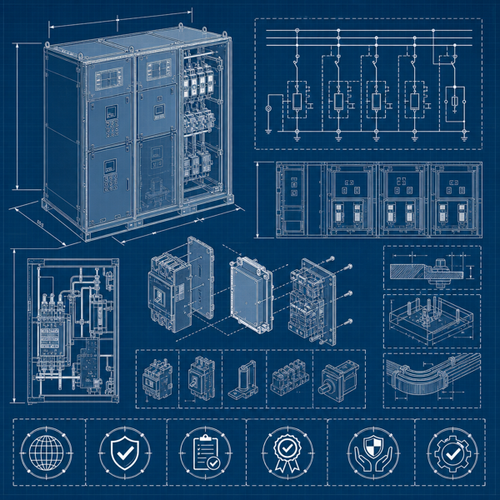
Low voltage switchgear and controlgear are at the heart of safe, efficient, and scalable electrical power distribution in the 21st century. As industries shift toward digitalization, renewable energy sources, and intelligent systems, the standards governing these devices and assemblies have never been more crucial. This guide explores four key IEC international standards that set requirements and provide guidance for modern electrical installations, covering semiconductor circuit-breakers, photovoltaic installations, product data management, and building information modelling. Understanding and implementing these standards enables organizations to boost productivity, ensure security, and confidently embrace new technologies in an increasingly connected world.
Overview / Introduction
Electrical power distribution relies heavily on robust, reliable, and secure low voltage switchgear and controlgear. These systems protect both people and assets from electrical faults, ensure operational continuity, and facilitate the integration of new technologies such as renewable energy generation and smart digital systems. However, as electrical installations become ever more complex and interconnected, the risk of technical failures, data mismanagement, and compliance gaps increases. Standards—such as those published by the International Electrotechnical Commission (IEC)—provide a proven framework for mitigating these risks, improving performance, and ensuring the safety and scalability of power distribution networks.
From supporting solar PV installations to integrating low voltage equipment data into digital design tools like BIM, recent standards address not only hardware but also digital information management. In this comprehensive article, you’ll discover:
The specific requirements and implications of four cornerstone international standards
Who should comply and why these standards are now indispensable
Practical insights for seamless implementation and future-readiness
How compliance supports growth, security, and competitive advantage
Whether you are an electrical engineer, operations manager, procurement specialist, or installer, mastering these standards is key to building and scaling efficient, secure, and intelligent electrical infrastructures.
Detailed Standards Coverage
IEC 60947-10:2026 – Standards for Semiconductor Circuit-Breakers
Low-voltage switchgear and controlgear – Part 10: Semiconductor circuit-breakers
As modern electrical systems demand faster response and improved reliability, semiconductor circuit-breakers (SCCBs) and hybrid circuit-breakers (SCHCBs) are increasingly replacing traditional mechanical devices in specific applications.
Scope & Key Coverage: IEC 60947-10:2026 applies to semiconductor and hybrid circuit-breakers for use in AC (up to 1,000 V) or DC (up to 1,500 V) networks, designed for installation and operation by trained personnel. This standard encompasses:
SCCBs with semiconductor switching elements and mechanical contacts for isolation
SCHCBs with parallel semiconductor and mechanical switching elements plus series mechanical isolators
It defines requirements irrespective of construction methods, rated currents, or application areas, ensuring broad applicability across industries.
Key Requirements & Specifications: IEC 60947-10 outlines necessary properties and behaviors:
Normal and abnormal operational behavior (overload, short-circuit situations)
Dielectric properties and electromagnetic compatibility (EMC)
Product markings, instructional information, and safety considerations
Required type, serial, and special testing—including immunity to voltage fluctuations, environment resilience, mechanical shock, and more
Who Needs to Comply?
Manufacturers and users of low voltage switchgear, especially those utilizing solid-state switching technologies
Sectors with advanced automation, renewable integration, or sensitive loads (industrial plants, data centers, transport infrastructure)
Practical Implementation Implications: Implementing IEC 60947-10 ensures:
Robust protection against modern electrical faults (addressing faster transient events)
Consistency in operation, contributing to overall system safety
Streamlined design approval and equipment certification
Enhanced operator information (labelling/instructions), contributing to decreased error rates and improved safety protocols
Notable Features:
Covers both AC and DC semiconductor circuit-breakers up to 1,500V DC
Comprehensive construction, testing, performance, and marking specifications
Considers environmental, mechanical, and EMC factors
Access the full standard: View IEC 60947-10:2026 on iTeh Standards
IEC 61439-8:2026 – Assemblies for Use in Photovoltaic Installations
Low-voltage switchgear and controlgear assemblies – Part 8: Assemblies for use in photovoltaic installations
The rapid growth of solar energy, both at utility and building scale, drives new challenges for electrical protection, energy management, and compliance. IEC 61439-8:2026 provides the defining requirements for low-voltage assemblies used in photovoltaic applications, ensuring that such systems are safe, durable, and efficient.
Scope & Key Coverage: This standard addresses photovoltaic assemblies (PVAs):
Used to combine DC electrical energy (input/output voltage ≤1,500 V DC)
Handling AC supply (auxiliary/control circuits ≤1,000 V AC)
For stationary, enclosed, either indoor or outdoor installations
Normally operated by authorized persons, but may be located in public areas
IEC 61439-8 details:
Definitions, service conditions, and technical characteristics
Construction and performance criteria for PVA enclosures
Verification and testing of assemblies
Requirements for accessories, controls, and integration of DC distribution equipment
Key Requirements & Specifications:
Specifies test methods for temperature, mechanical strength, dielectric strength, internal separation, and solar exposure
Guidance for safe integration of standardized devices (fuses, breakers), but excludes stand-alone components not forming part of PVA
Does not apply to power conversion equipment (handled by IEC 62109) or assemblies covered by other IEC 61439 parts
Incorporates requirements for environmental exposure relevant to PV, such as IP codes, UV, and mechanical impact resistance
Who Needs to Comply?
Manufacturers and assemblers of low voltage distribution panels for solar energy systems
Electrical contractors and system integrators delivering rooftop, commercial, or utility-scale PV
Project teams seeking to certify installations according to best practice and legal requirements
Practical Implementation Implications: Implementing this standard results in:
Increased safety of PV installations under all weather and operational conditions
Clear product selection and configuration guidelines for design teams
Faster permitting and regulatory acceptance
Strong interoperability, supporting larger and more complex PV projects
Notable Features:
Covers full lifecycle: design, integration, operation
End-to-end requirements for both manufactured series and customized assemblies
Enhanced clarity in testing and documentation for all assembly types
Access the full standard: View IEC 61439-8:2026 on iTeh Standards
IEC 62683-1:2026 – Product Data and Properties for Information Exchange (Catalogue Data)
Switchgear, controlgear and their assemblies for low-voltage – Product data and properties for information exchange – Part 1: Catalogue data
Data transparency and digital transformation are changing how electrical systems are designed, procured, installed, and managed. Accurate and standardized product data is essential for modern supply chains, digital catalogues, and engineering workflows. IEC 62683-1:2026 offers the foundational reference dictionary for categorizing and exchanging information about low voltage switchgear, controlgear, and their assemblies.
Scope & Key Coverage: IEC 62683-1 provides:
A standardized dictionary of properties and classes for low-voltage switchgear and controlgear equipment
Definitions that support electronic product data exchange, especially for use in digital catalogues and software tools
Each property features clear identification, definition, formatted values, and (where appropriate) standardized units
Covers typical device classes (contactors, circuit-breakers, control auxiliaries), device properties, and assembly classifications
This standard is directly referenced by other digital engineering and supply chain platforms, making it a cornerstone for seamless information exchange across companies and borders.
Key Requirements & Specifications:
Consistent naming conventions and definitions
Structured property lists to reduce ambiguity in product identification and selection
Reference to the IEC Common Data Dictionary (CDD) for ongoing updates and harmonization
Updated device and assembly classes, including new categories in this edition
Who Needs to Comply?
Manufacturers providing data for digital catalogues or BIM tools
Engineering and procurement professionals
System integrators requiring exact specification matching and easier automated selection
Software developers working in electrical engineering and design
Practical Implementation Implications: Adopting IEC 62683-1:
Accelerates digital procurement and design through consistent product identification
Reduces risk of errors in specifying or ordering products
Supports MRO (maintenance, repair, operations) efficiency through clear asset tracking
Enhances interoperability between different software and data environments
Notable Features:
Includes new device and assembly class descriptions and attributes
Each property is unambiguously defined, with value lists and units as needed
Supports the latest technical changes required for integration with IEC CDD and engineering platforms
Access the full standard: View IEC 62683-1:2026 on iTeh Standards
IEC 62683-2-2:2025 – Product Data and Properties for Information Exchange – Engineering Data (BIM)
Low-voltage switchgear and controlgear – Product data and properties for information exchange – Engineering data – Part 2-2: Switchgear and controlgear assembly objects for building information modelling
As construction and facility management move into the digital era, building information modelling (BIM) has become a standard tool for improving project efficiency, risk management, and operational intelligence. IEC 62683-2-2:2025 bridges low voltage switchgear data with the BIM world, specifying the attributes and object models used to digitally represent assemblies throughout the building lifecycle.
Scope & Key Coverage:
Defines BIM object models for all assemblies covered by the IEC 61439 series that are installed in buildings
Specifies required and optional physical, functional, and service-related data for model-based project workflows
Designed to supply the ISO 16739 ‘Industry Foundation Classes’ BIM process
Excludes details about internal components, specific electrical configurations, or logistics—but captures key product and interface information
Key Requirements & Specifications:
Digital representations include geometry, attributes, and connectors for advanced design and coordination
Supports standard BIM object classification and property assignment methodologies
Includes step-by-step guidance for creating new BIM objects and enriching data
Ensures interoperability with global data standards (IEC CDD, bSDD, and IFC)
Who Needs to Comply?
Manufacturers supplying BIM-ready product data
Engineers and designers using BIM for electrical system planning
Construction and facilities management teams optimizing lifecycle asset data
Practical Implementation Implications: Following this standard enables:
Consistent, efficient inclusion of switchgear data into digital building models
Greater transparency in design, installation, and maintenance
Easier coordination between MEP (mechanical, electrical, plumbing) trades
Future-proofing asset documentation for digital twin applications
Notable Features:
First comprehensive BIM standard for low-voltage electrical assemblies
Ensures data is ‘BIM-ready’ for seamless integration at all building phases
Fosters collaboration and integration across the construction ecosystem
Access the full standard: View IEC 62683-2-2:2025 on iTeh Standards
Industry Impact & Compliance
How These Standards Affect Businesses
Implementing these standards is now essential for companies operating in power distribution, industrial automation, construction, renewable energy, and digital infrastructure sectors. With the global drive toward smart, sustainable, and digitalized grids, adhering to modern standards:
Reduces project risk by specifying roles, behaviors, and safety margins
Simplifies supply chain communications through standard data and product descriptions
Speeds up regulatory approvals—as compliance to recognized standards is often a permitting requirement
Drives competitive advantage via better, safer, and more future-ready products and services
Compliance Considerations
Compliance is typically specified in contracts and tenders
National legislation and insurance standards often require proof of conformity
Third-party certification against these IEC standards ensures objective quality
Benefits of Adoption
Improved operational reliability and safety
Scalability—installations can grow or integrate with new technologies without unexpected compatibility issues
Increased productivity—especially via digital workflows, reduced errors, and more effective maintenance
Enhanced cybersecurity and system resilience
Risks of Non-Compliance
Increased likelihood of technical failures or safety incidents
Regulatory fines or denial of operation
Reputation damage and lost business opportunities
Higher long-term operating costs due to non-standardized equipment and poor interoperability
Implementation Guidance
Common Implementation Approaches
Gap Assessment: Review current products and documentation to identify needs for updating or alignment
Training: Equip engineering, procurement, and operations staff with the knowledge of latest standard requirements
Supplier Audits: Ensure all partners provide equipment and data aligned to these IEC standards
Documentation: Maintain records of compliance, including test reports and marking information
Digital Integration: For data and BIM standards, align internal catalogues and design tools to standardized dictionaries
Best Practices for Adoption
Stay up to date with the latest editions and technical revisions
Integrate digital standards (IEC 62683 series) early in design & procurement
Engage with certification and testing labs for type and routine tests validation
Use standardized data, labels, and documentation in all projects
Collaborate with manufacturers for custom or advanced product requirements
Resources for Organizations
Access standards through reputable platforms like iTeh Standards
Participate in professional seminars and webinars on IEC standards
Engage with industry organizations and working groups
Regularly review updates and new publications from IEC
Conclusion / Next Steps
International standards for low voltage switchgear and controlgear—ranging from advanced semiconductor circuit-breakers to the digital exchange of product and BIM data—are foundational to the success of modern electrical systems. By adopting the principles and requirements of IEC 60947-10, IEC 61439-8, IEC 62683-1, and IEC 62683-2-2, organizations can ensure that their electrical infrastructure is safe, future-ready, and competitive.
Key Takeaways:
These standards address emerging challenges in safety, digital transformation, renewable integration, and supply chain efficiency
Proactive compliance improves productivity, operational security, and scalability
Implementation is increasingly a legal and commercial requirement for global projects
Recommendations:
Assess your organization’s current practices, identify compliance gaps, and prioritize immediate alignment with these standards
Provide staff with educational resources and access to authoritative guidance platforms
Explore the standards in detail to future-proof operations and gain a competitive edge
Ready to future-proof your electrical infrastructure? Explore these and other key IEC standards today at iTeh Standards and unlock safer, smarter, and more reliable operations.


Comments